

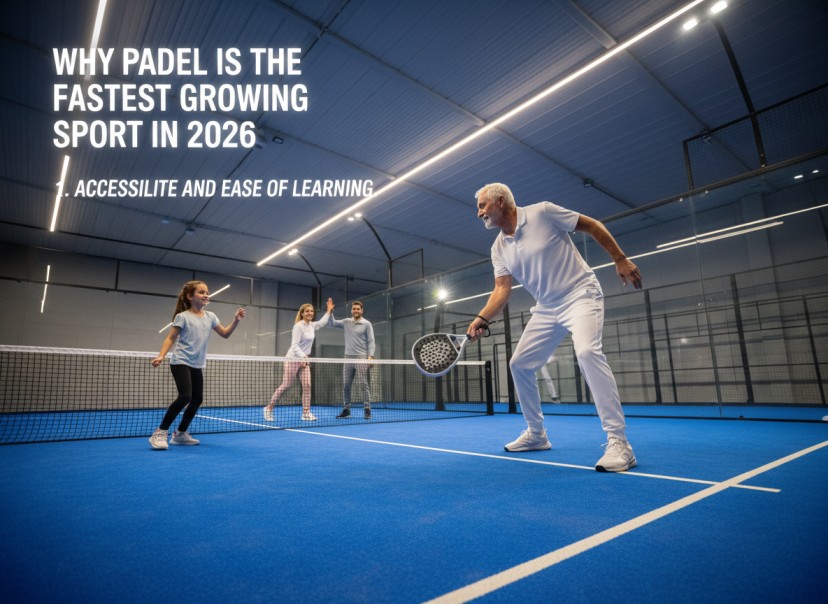
In the ever-evolving world of athletics, a new king of the court has officially claimed its throne. As we move through 2026, the padel sport has transitioned from a niche European pastime into a global juggernaut. With over 35 million active players across 150 countries, it isn’t just a trend; it is a full-scale sporting revolution.
Whether you are a seasoned tennis player looking for a fresh challenge or a beginner searching for a social way to stay fit, padel offers a unique “easy to learn, hard to master” appeal that other racket sports struggle to match. In this guide, we’ll explore the meteoric rise of padel, how it stacks up against its rivals, and why it has earned the title of the fastest growing sport 2026.
What is Padel?
If you haven’t stepped onto a court yet, you might be wondering: what is padel?
At its core, padel is a racket sport that combines the best elements of tennis and squash. It is almost exclusively played in doubles on an enclosed court made of glass and mesh. The court is roughly one-third the size of a standard tennis court (20m x 10m), which creates a much more intimate and fast-paced environment.
The most defining feature of the padel sport is the use of the walls. Much like squash, players can hit the ball off the glass to keep a rally alive, leading to spectacular points and strategic depth. The rackets are solid, perforated composite paddles (no strings!), and the balls are similar to tennis balls but with slightly less pressure to account for the smaller court size.
Why Padel Is Growing So Fast in 2026
The surge in padel popularity worldwide isn’t an accident. Several key factors have converged to make it the dominant recreational activity of the year.
1. The Low Barrier to Entry
Unlike tennis, which can take months of lessons just to hold a consistent rally, beginners can enjoy a competitive game of padel within 10 to 20 minutes of picking up a racket. The underhand serve and the ability to use the walls mean the ball stays in play longer, reducing the frustration for newcomers.
2. Social Connectivity
Because the court is small and the game is played in doubles, conversation is part of the experience. Padel is inherently social, often described as “chess on legs” with a “cocktail party” atmosphere. Many modern padel clubs in 2026 are designed with high-end cafes and social lounges, making it as much about the post-game hangouts as the match itself.
3. Smart Infrastructure and High ROI
From a business perspective, padel is a goldmine. You can fit two or even three padel courts into the space of one traditional tennis court. This higher density allows clubs to accommodate more players per hour, leading to better revenue. In 2026, the global padel club market is projected to exceed €4 billion as hotels, resorts, and urban developers repurpose underutilized spaces into vibrant padel hubs.
4. Celebrity Endorsements
The sport’s profile has been boosted by “mega-fans” like David Beckham, Serena Williams, and Neymar. Their visibility has helped the padel sport break into markets like the US, UAE, and India, where it was previously unknown.
Padel vs Pickleball: Which Should You Choose?
The debate of padel vs pickleball has become the defining rivalry of the racket sport world. While both have seen explosive growth, they offer very different experiences.
| Feature | Padel | Pickleball |
| Court Type | Enclosed (Glass/Mesh Walls) | Open Court |
| Ball Type | Pressurized (Like Tennis) | Hard Plastic (Wiffle Ball) |
| Strategy | High use of rebounds and angles | Focus on “dinking” and net play |
| Physicality | High (more running/lunging) | Moderate (smaller court/less movement) |
| Equipment | Perforated carbon fiber racket | Lightweight flat paddle |
While pickleball is often praised for its extreme accessibility for seniors, padel is winning over the 20–45 age demographic. Padel offers a more “three-dimensional” game due to the walls, providing a higher level of athletic intensity that appeals to those looking for a serious workout.
The Essential Padel Rules
To get started, you only need to know a few basic padel rules. The scoring system is identical to tennis (15, 30, 40, Game), but the mechanics of play differ:
- The Serve: All serves must be underhand and struck at or below waist height. The ball must bounce once in the opponent’s diagonal service box.
- The Walls: During a rally, the ball must always hit the ground on the opponent’s side before hitting a wall. Once it bounces, it can hit the glass or mesh and remain in play.
- Volleys: Players can volley the ball (hit it before it bounces), except when returning a serve.
- The “Golden Point”: Many professional and amateur leagues now use a “no-advantage” rule at deuce to keep the matches fast and exciting.
Health Benefits of Playing Padel
The benefits of playing padel go far beyond the scoreboard. Because it requires constant movement and mental agility, it is one of the most effective full-body workouts available.
Cardiovascular Endurance
A typical one-hour match can burn between 500 to 800 calories. The stop-and-start nature of the game acts as a form of High-Intensity Interval Training (HIIT), strengthening your heart and improving lung capacity.
Mental Sharpness and Coordination
The fast pace of the padel sport requires split-second decision-making. Learning to read the ball’s bounce off the glass improves hand-eye coordination and spatial awareness. Additionally, the social nature of the sport has been linked to lower levels of stress and anxiety, as players feel part of a community.
Low Impact on Joints
While it is an active sport, the synthetic turf used on most courts provides excellent shock absorption. Compared to the hard concrete of a tennis or pickleball court, padel is much gentler on the knees and ankles, allowing for a longer playing “career” as you age.
The Future of Padel Sport
As we look toward the end of the decade, the trajectory for padel is clear. Experts predict that the number of courts worldwide will double again by 2030. We are also seeing a massive push for padel to be included in future Olympic Games, which would cement its status as a top-tier global sport.
The padel popularity worldwide is currently highest in Spain and Argentina, but the “growth engines” of 2026 are the United States, the UK, and the Asia-Pacific region. With technological advancements like “Smart Rackets” that track your swing speed and professional tours like Premier Padel offering million-dollar prize pools, the sport has finally arrived at the center stage.
Conclusion
The padel sport has successfully captured the zeitgeist of 2026. It is fast, social, easy to learn, and incredibly addictive. By combining the strategic depth of squash with the familiarity of tennis, it has created a unique space that appeals to everyone from professional athletes to weekend warriors.
If you haven’t tried the fastest growing sport 2026 yet, there has never been a better time to grab a racket and find a local court. You might just find your new favorite obsession.